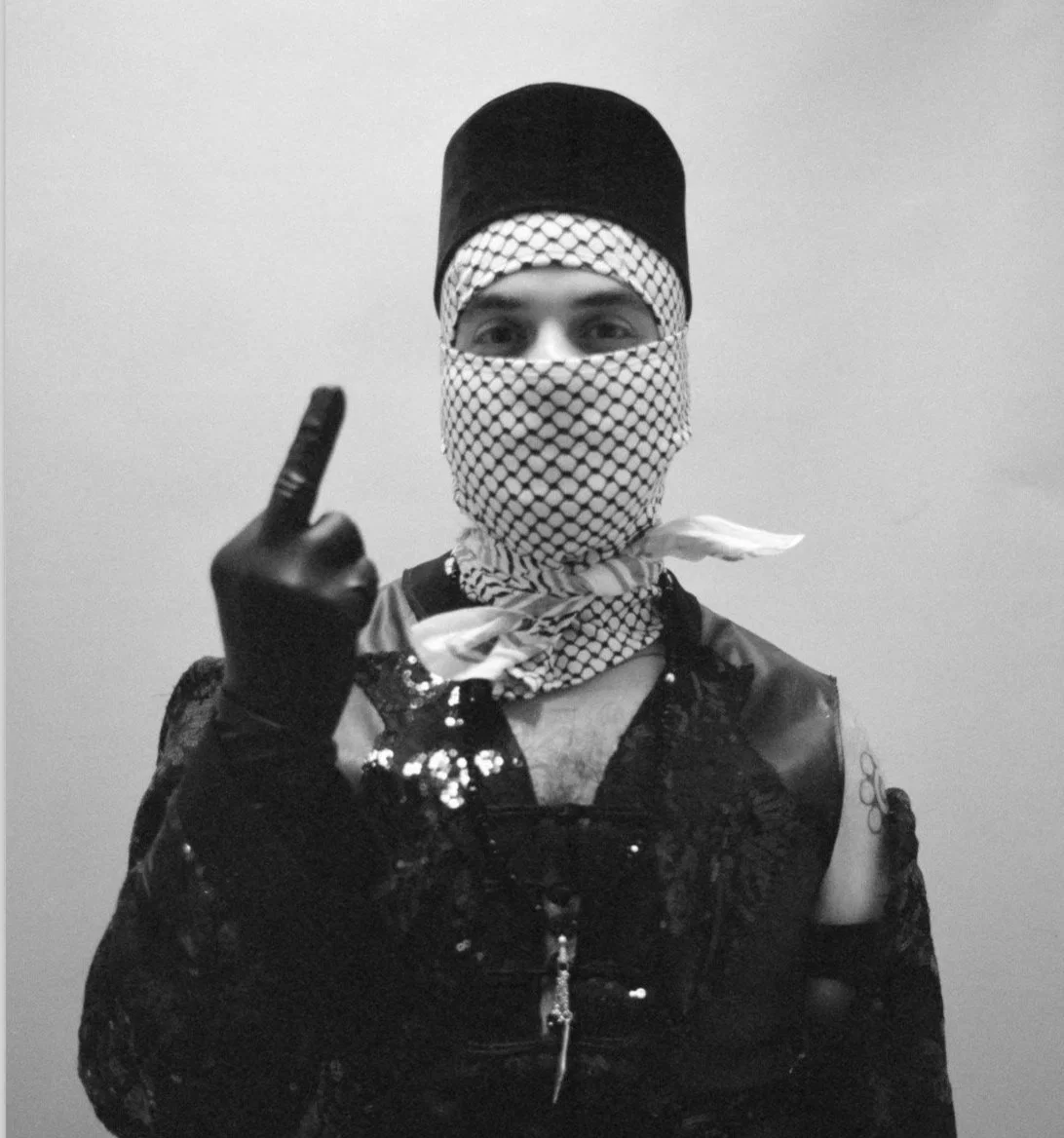
A person dressed with a keffiyeh and a tall black hat, wearing a face covering, making an offensive gesture with the middle finger. Overlaid text in red Arabic script reads 'ماما غيرت'.

Who is Mama Ganuush?

Background

Mama Ganuush is a disabled Muslim trans Palestinian performance artist, writer, filmmaker, producer, and community organizer whose multidisciplinary work merges performance with anti-colonial resistance.

Born to a father displaced from Yafa (يافا) during the Al-Nakba (النكبة) to the refugee camps in Gaza, and a mother from Gaza displaced during Al-Naksa (النكسة), Mama Ganuush's identity and art are inseparable from Palestinian liberation. They identify as Trans Nonbinary and Muslim, and are a survivor of conversion therapy, displacement, and live with multiple sclerosis - experiences that deeply inform their advocacy for queer, disabled, Muslim, Arab, and Palestinian rights.

Artistic Practice

Performance Art:
Mama Ganuush describes their performance art as an expression of Palestinian queer futurism. Their dance blends Egyptian golden-era belly dance, Palestinian folk traditions, and improv theater. Through movement, they imagine what Palestinian art could have become if colonization had never interrupted it - dreaming of a queer Palestinian dance unfolding inside Cinema Al-Hambra in Yafa, where their father once watched films before 1948.

Writing:
Their writing builds Indigenous solidarity with Palestine. They compose poems in Arabic rooted in Indigenous forms of expression, then collaborate with local artists to translate them into both their spoken language and ancestral Indigenous languages - creating living testimonies to connections between Indigenous struggles across continents.

Filmmaking:
A Message is Mama Ganuush's 2025 short documentary offering a "surrealist exploration of diaspora identity," channeling inherited trauma from their father's displacement from Yaffa and mother's roots in Gaza into radical creative expression. The film premiered at the JAHA Film Festival's "Unraveling Roots" program in Lisbon on December 7, 2025.

Founding Organizations

Mama Ganuush is the founder and executive producer of the Heritage Activists and Liberation Artists (HALA) Collective, a digital and physical platform amplifying anti-colonial artists and centering Palestinian liberation through storytelling, open salons, community events, and performance arts.

From this foundation, they produce work that builds explicitly anti-colonial spaces:

Cabaret Palestina (2024): A fundraising cabaret supporting drag artists who withdrew labor from San Francisco Pride in solidarity with Palestine, with proceeds going to performers who refused to align with oppressors.

Pink Wash: The Comrades' Dance Party: A sliding-scale day party in San Francisco where performers are paid fairly, Palestinian and Indigenous people enter free, and proceeds support grassroots mutual aid.

Salon HALA: A queer art salon blending community recognition, live performances honoring elders and activists, with proceeds supporting mutual aid efforts in Gaza.

JAHA Film Festival (2025): Founded and produced in Lisbon, Portugal - an international film festival celebrating trans and gender variant filmmakers from Indigenous communities and the Global South. Over 1,100 submissions were culled to 21 films using cinema as a tool for collective liberation. Mama Ganuush also established the JAHA Trans Liberation Film School, developing freely available curriculum with scholars Eric A. Stanley and dee(dee) c. ardan.

Organizing and Activism

Mama Ganuush organizes across protests, hunger strikes, and workshops that deconstruct colonial propaganda—rooted in the belief that queer liberation is inseparable from Palestinian freedom. They organize alongside AROC (Arab Resource and Organizing Center), Jewish Voice for Peace, IJAN (International Jewish Anti-Zionist Network), QUIT (Queers Undermining Israeli Terrorism), and other grassroots organizations.

Legal and Direct Action:
In late 2023, Mama Ganuush joined Defense for Children International - Palestine v. Biden, a federal lawsuit challenging U.S. funding of Israel's military campaign in Gaza as complicity in genocide. When courts dismissed the case, they escalated resistance: on October 19, 2024, they launched a hunger strike demanding an end to the killing, starving, and displacement of Palestinians. They subsisted on only fluids until their multiple sclerosis required other community members to continue the strike in solidarity—ultimately reaching 51 days.

Fashion Week Protest:
In February 2024, Mama Ganuush walked as a model for designer Victor Pugeili at New York Fashion Week, using the platform to protest genocide while calling out Getty Images for supplying imagery that sanitizes Israeli state violence.

Educational Workshops:
They lead workshops at universities including Stanford ("Defying Pinkwashing in the Trump Era") and support student-led movements at UC Berkeley and beyond—taking the megaphone at divestment protests, organizing die-ins on Castro Street with QUIT and Gay Shame, and co-organizing the "No Pride in Genocide" march on Pride Sunday.

EuroPride 2025 Opposition:
When Mama Ganuush learned EuroPride 2025's municipal commissioner had previously served as press attaché for the Israeli Embassy—and that the same association had co-hosted an "Israeli Pride Party" with that embassy—they joined over 60 Portuguese LGBTI+ collectives in issuing a public declaration: EuroPride must reject normalization with those who commit human rights violations. The Marcha do Orgulho LGBTI+ de Lisboa stood with them, ensuring Lisbon's authentic Pride remains rooted in anti-colonial struggle.

Through every medium and action, Mama Ganuush presents Palestinians not as subjects of tragedy but as architects of freedom—centering voices from outside the gender binary who are telling stories the world needs to see. Whether in federal court, on runways, in workshops, or in hunger strike solidarity, their organizing is the practice of collective liberation: showing up, passing the mic, and building worlds where all of us are free.

Al-Nakba refers to catastrophe in Arabic and t marks the ethnic cleansing of over 750,000 Palestinians from their homes and land. to establish the colonial state of Israel on indigenous Palestinian lands. To learn more about the history and memory of Al-Nakba, several key resources offer critical perspectives. Foundational texts include Constantin Zureiq's The Meaning of the Nakba and Nur Masalha's The Palestine Nakba, while documentaries such as Benny Brunner's Al-Nakba: The Palestinian Catastrophe 1948 and Al Jazeera's four-part series provide compelling visual accounts. For those interested in firsthand narratives, the Palestinian Oral History Archive at AUB preserves the testimonies of survivors.

Al-Naksa , or "the Setback," refers to the Six-Day War of June 1967, a defining moment that resulted in Israel's occupation of the remaining 22 percent of historic Palestine, including the West Bank, East Jerusalem, and the Gaza Strip. For Palestinians, this was a second catastrophe, leading to the displacement of an estimated 280,000 to 325,000 people, many of whom were already refugees from the 1948 Nakba . The war also saw the destruction of numerous villages, such as Imwas, Yalo, and Bayt Nuba. Key historical analyses can be found in works like Tom Segev's 1967: Israel, the War, and the Year That Transformed the Middle East and Nur Masalha's The Politics of Denial: Israel and the Palestinian Refugee Problem, while the Interactive Encyclopedia of the Palestine Question (palquest.org)provides an in-depth, authoritative timeline of the war and its aftermath . The Naksa is commemorated annually on June 5th as a reminder of the ongoing occupation and the denial of Palestinian rights .